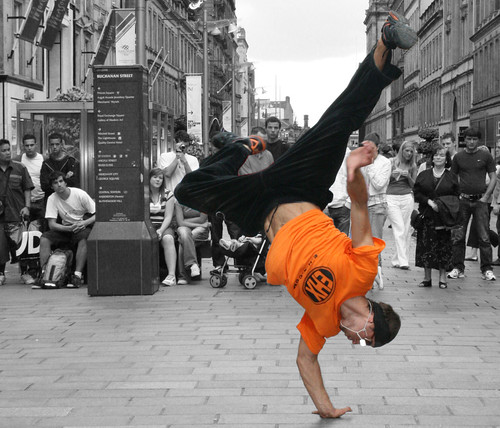
Dance is a sport and art form that generally refers to movement of the body, usually rhythmic and to music, used as a form of expression, or presented in a spiritual or performance setting.
Definitions of what constitutes dance are dependent on social, cultural artistic and moral constraints. Every dance, no matter what style, has something in common. It not only involves flexibility and body movement, but also physics. If the proper physics is not taken into consideration, injuries can and are likely to occur.
Following is a compilation of The 10 Most Famous Dance Forms Around The World:
1. Kathak Dance 
Kathak is one of the eight forms of Indian classical dances, originated from northern India. This dance form traces its origins to the nomadic bards of ancient northern India, known as Kathaks, or story tellers. These bards, performing in village squares and temple courtyards, mostly specialized in recounting mythological and moral tales from the scriptures, and embellished their recitals with hand gestures and facial expressions. It was quintessential theatre, using instrumental and vocal music along with stylized gestures, to enliven the stories.
2. Bhangra Dance
Bhangra is a form of music and dance that originated in the Punjab region of primarily Pakistan and India. It was one of the traditional dances of the Punjab region split between India and Pakistan and shared some of its origins with similar dances in northwest India, Afghanistan and even Iran. It further became synthesized after the partition of India in which Sikh and Hindu refugees in India shared their folk dances from their former homes in today’s Pakistan.
3. Street Dance 
Street dance, also called vernacular dance is an umbrella term, used to describe dancestyles that evolved outside of dance studios in everyday spaces such as streets, school yards and nightclubs.
Street dance is also commonly used specifically for the many hip hops and funkdance styles that began appearing in theUnited States in the 1970s, and are still alive and evolving within hip hop culture today: such as break dance, popping, locking,hip hop new style and house dance.
4. Samba Dance 
Samba is a lively, rhythmical dance of Brazilianorigin in 2/4 time danced under the Samba music. However, there are three steps to every bar, making the Samba feel like a 3/4 timed dance. Its origins include the Maxixe.
The Samba music rhythm has been danced in Brazil since its inception in the late 19th century. There is actually a set of dances, rather than a single dance, that define the Samba dancing scene in Brazil; thus, no one dance can be claimed with certainty as the “original” Samba style. Another major stream of the Samba dance besides the Brazilian Samba dancing styles is Ballroom Samba which differs significantly.
5. Belly Dance 
Belly dance is a Western term for a traditionalEgyptian dance genre known as raqs sharqi or sometimes raqs baladi literally “dance of country”, and so “national” or “folk” dance. Some American devotees refer to it simply as “Middle Eastern Dance.” It is sometimes referred to as Çiftetelli, a Turkishterm. The term “belly dance” is a creation of, first used in English Orientalism in 1899, and translating in French to “danse du ventre.”
6. Ballet Dance 
Ballet is a formalized type of performative dance, the origins of which date lay in sixteenth- and seventeenth-century Frenchcourts, and which was further developed inEngland, Italy, and Russia as a concert danceform. The early performances preceded the intervention of the proscenium stage and were presented in large chambers with the most of the audience seated on tiers or galleries on three sides of the dancing floor. The early ballet dancers were not as highly skilled as they are now. It has since become a highly technical form of dance with its own vocabulary.
7. Tap Dance 
Tap dance was developed in the United States during the nineteenth century, and is popular in many parts of the world. The name comes from the tapping sound made when metal plates on the dancer’s shoes touch a hard surface. Because the dancer makes sound, they are also considered apercussive musician.
8. Ballroom Dance 
Ballroom dance refers to a set of partner dances, which are enjoyed bothsocially andcompetitivelyaround the globe. Itsperformance andentertainment aspects are also widely enjoyed onstage, in film, and on television.
While historically ballroom dance may refer to any form of formal social dancing as recreation, with the emergence of dance sport in modern times the term has become much narrower in scope, usually referring specifically to the International Standard and International Latin style dances. In the United States, two additional variations “American Smooth” and “American Rhythm” have also been popularized and are commonly recognized as styles of “ballroom dance”.
9. Salsa Dance 
Salsa is a dance for Salsa music created by Spanish-speaking people from the Caribbean and their immigrant communities in the US. Salsa dancing mixes African and European dance influences through the music and dance fusions.
Salsa is normally a partner dance, although there are recognized solo forms, line dancing (suelta), andRueda de Casino where groups of couples exchange partners in a circle. Salsa can be improvised orperformed with a set routine.
The name “Salsa” is the Spanish word for sauce, connoting (in American Spanish) a spicy flavor. Salsa also suggests a “mixture” of ingredients, though this meaning is not found in most stories of the term’s origin.
10. Pole Dance
Pole dancing is a sport and a form of performing art, a combination of dancing and gymnastics. It involves dancing sensually with a vertical pole and is often used instrip clubs and gentlemen’s clubs, although more recently artistic pole dancing (Chinese poles) is used incabaret/circus and stage performance in a non-erotic environment.
Pole dancing is now regarded as a recognized form of exercise and can be used as both an aerobic and anaerobicworkout. Recognized schools and qualifications are being developed as pole dancing increases in popularity, with the overall sex appeal toned down.
I hope u all will like this.